
The long-running family rivalries behind the Qatar crisis | World news
It is a row that is roiling the Middle East, pitting the wealthiest and most influential Arab sheikhdoms against each other, and sparking weeks of shuttle diplomacy. However, behind the Saudi Arabia-led blockade of Qatar’s air, land and sea ports lies a long-running family feud.
Saudi Arabia, the United Arab Emirates, Bahrain and Egypt severed diplomatic ties last month with the uber-rich Gulf state of Qatar, which shares the world’s largest reservoir of gas with Iran, Riyadh’s hated rival. The bloc accuses Qatar of supporting terrorism, a charge it denies.
The blockade attempts to cut Qatar off from the rest of the world: the land border has been sealed, Qatari overflights banned and shipping lanes closed. The Saudi-led coalition issued 13 demands to lift the blockade, which included shutting al-Jazeera, the TV voice of the Arab spring, and dropping support for the Muslim Brotherhood. Despite US intervention, little has been resolved.
Diplomats in the region say the issues cannot be resolved, partly because they are not just political â€" they are personal, too.
“The rulers have familial relationships and the kinship ties between the Saudis, the Emiratis and the Qataris … they are very, very close to each other,†said one highly-placed source in the region. “This means big political issues are also family issues. Those become very difficult to solve, especially when the Saudis and the Emiratis want regime change.â€
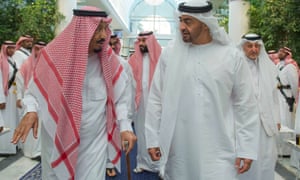
In the fractious world of Middle Eastern politics, where absolute monarchs trade on their bloodline and piety, family dissent is often stalled by dispersing privilege and cash. However, these are tumultuous times in the Arab world, which makes this “Game of Thrones†dispute all the more dangerous.
The UAE and Saudi Arabia are both trapped in a costly and open-ended war in Yemen. Plummeting oil prices hit both economies hard. Qatar, which is more dependent on gas, is tightening its belt, too, but its population is smaller and wealthier in per capita terms than its two larger neighbours.
On paper, the current ruler of Qatar is Emir Tamim bin Hamad al-Thani, the 37-year-old son of Sheikh Hamad, who formally abdicated in Tamim’s favour in 2013.
However, Simon Henderson, an influential analyst at the Washington Institute, wrote recently that Hamad, now known as the “father-emir,†was still pulling the strings â€" a view widely shared in the Middle East.

In many ways, Hamad is the founder of the new assertive Qatari identity. He picked his fight with the Saudis first on the battlefield when commanding a brigade of Qataris against Saddam Hussein in the Persian Gulf war almost 30 years ago.
The soldiers of the Hamad brigade were among the first coalition troops to engage Iraqi forces at the battle of Khafji in February 1991. When Saudi forces joined the battle, however, US marines ended up protecting Saudi troops because their Arab allies from Qatar were accidentally raining “friendly fire†on them.
Things were patched up swiftly after the war but worry lingered, especially as Hamad returned as supreme military commander and a newly decorated war hero. He continued to rile Riyadh, telling the Saudis over a border dispute in 1992 that they would answer to the “barrel of a gunâ€.
These fears were realised when the young sheikh deposed his father, Khalifa, who had left the country for Geneva, where he was allegedly undergoing medical treatment. Hamad sent tanks to surround the royal court, which surrendered meekly.
Since then, he has been a disruptive force in the region. Sheikh Hamad founded al-Jazeera, which, along with social media, has in recent years stirred public opinion in ways Arab governments â€" especially the Saudis â€" did not appreciate.
Many believe the current conflict may be rooted in these old rivalries. The source agreed, telling the Guardian: “The Saudis and the Emiratis told the current emir ‘you make your father submit to us’. They moved very aggressively against the father. How can the son do that?â€
The Sauds’ influence in Qatar has long been through prominent families, most notably that of the Attiyahs, who are their blood relations. Hamad was brought up not by al-Thanis but in the house of his maternal uncle, an Attiyah.
However, rather than marry an Attiyah to continue ties with the Sauds, Hamad cemented his powerbase in the Thanis by marrying the daughters of two powerful uncles.
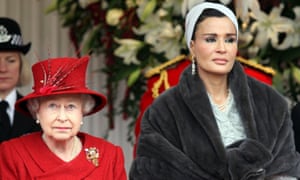
But his favourite spouse and mother of the current emir is Sheikha Mozah, the only wife he is seen in public with and who hails from a radical tradition. Her father, a commoner, had been jailed by Hamad’s father after making public call for the fair distribution of wealth in the country.
Hamad’s most influential adviser is not an Attiyah â€" another break from tradition â€" but a Thani, Hamad bin Jassim, who bet that buying influence within the rising force of political Islam would carve out long-term stability for the tiny state, a departure from the rest of the Gulf states.
Qatar’s foreign policy has its detractors. Fawaz al-Attiyah, a former Qatari diplomat, said that to him “and others who had to step back or be sidelined it was obvious that the ad hoc policy objectives and reckless strategies [by Doha] were bound to failâ€.
This was the backdrop to a rivalry between the Sauds and the Thanis, said a Qatari familiar with both, who are bound together by marriage and religion. Both the Thanis and Sauds originate from the peninsula’s Nejd interior, from where austere Wahhabism sprung. Both seek to claim their version of Wahhabism is the right path.
In Qatar, women are allowed to drive, unlike in Saudi Arabia. There are no religious police forcing businesses to shut during prayer times. Hamad has gone as far to claim the Thanis are related to al-Wahab, an affront to the Saudis who claim proprietorship over the austere version of Islam.
Allen Fromherz, academic and author of Qatar: Rise to Power and Influence, said: “Qatar really claims a Wahhabism of the sea. It’s a more open and flexible notion of Wahhabism than that of the desert. Sheikh Hamad’s claim of lineage to al-Wahhab may be a way of shoring up the legitimacy of this alternate vision of Wahhabism and a way of disarming those who would claim that Qataris are not truly Wahhabi In essence, Sheikh Hamad is trying to take the high road and move forward even faster than the Saudis.â€
Another factor is Hamad’s public backing of democracy; he told US television in 2003 that “any people that want to develop their countries ... have to practise democracy. That’s what I believe.†Although he did not make good on a promise to have an Qatari elected parliament in 2013, his backing of the ballot box annoyed neighbouring ruling families.
One of those angered by such talk was UAE’s crown prince and its de facto ruler, Sheikh Mohammed bin Zayed al-Nahyan, who has long harboured misgivings about Qatar. Cables obtained by WikiLeaks show him raging in 2009 that Qatar was just “part of the Muslim Brotherhoodâ€.
In fact, the UAE has often intervened in royal politics, backing different branches of the Thani clan. This began as soon Britain announced it would be leaving the Gulf in 1968 and plans were hatched for Qatar to be part of the UAE.

This idea was buried was in 1972 when the then Qatari emir, Sheikh Ahmad, who had proposed creating a greater federation of Arab Emirates and ruled languidly from his villa in Switzerland, was ousted while on a hunting trip in Iran by his cousin Sheikh Khalifa. Sheikh Ahmad ended up in Dubai and married the daughter of the city state’s fabulously wealthy emir.
UAE has since taken sides in Thani family rows, most notably for years allowing Hamad’s father to stay in their territory where he plotted counter-coups, all of which failed.
This was the setting when a pro-Saudi newspaper splashed on 1 June with the sensational news that the descendants of Sheikh Ahmad had “apologised†for Qatar’s present day rulers, whom they allegedly had “disownedâ€.
However, a Qatari with links to the royal court told the Guardian that this was “fake news from the Emirati intelligenceâ€. The UAE has denied it orchestrated the hacking of news sites in order to post incendiary false quotes or that it is destabilising the current regime.
The Qatari source said few sheikhs or family members wanted to be found on the wrong side of Doha’s power game, pointing out that dissident Thanis who had supported coup attempts faced dire consequences in the past. In 2001, Thanis had been sentenced to death for conspiring for the overthrow of Hamad.
The source added: “Sheikh Ahmad’s family [are] keeping their heads down. No one is saying anything.â€
0 Response to "The long-running family rivalries behind the Qatar crisis | World news"
Posting Komentar